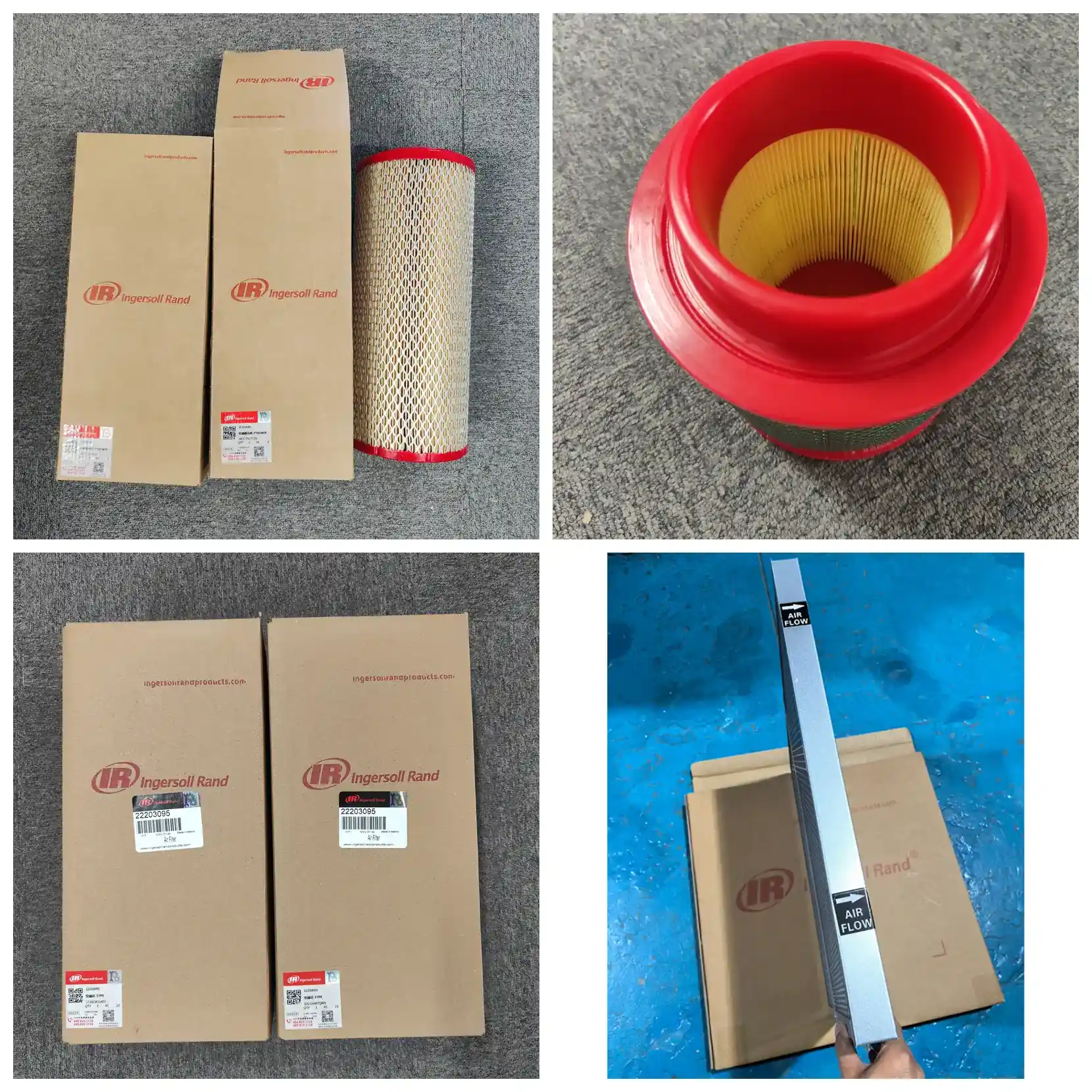
Product
Ingersoll Rand 47742049001 Air Filter Element | MM350-2S 350 kW
Ingersoll Rand 47742049001 air filter element for MM350-2S two-stage screw compressors (350 kW, 8.5 bar(g), 64.1 m³/min). 5–10 μm filtration, 2000-hour or 3-month service interval. Verify the part number on the old element before ordering — this platform uses multiple filter part numbers.
- Export packaging & documentation support
- OEM / ODM customization available
- Sample and bulk order workflow
Product Overview
47742049001 is the intake air filter element for the Ingersoll Rand MM350-2S two-stage rotary screw air compressor. It sits inside the external air filter housing, upstream of the airend intake. Ambient air passes through the element first; dust, grit and fibres are trapped on the media surface and in its depth, so only clean air reaches the airend.
One point buyers must understand before ordering: the MM350-2S intake system does not use a single filter part number. Air filter configuration varies with machine version and build, and several element part numbers run in parallel. This page therefore makes no assumption that one element covers the whole machine. Always read the part number moulded on the old element and confirm its mounting position rather than ordering on machine model alone. This is the single most common sourcing error on high-power compressor consumables.
Duty context: the MM350-2S is a 350 kW two-stage machine with 64.1 m³/min displacement at 8.5 bar(g) — a high-volume intake duty. The element handles far more air per hour than mid-size machines, so filtration area and structural rigidity must match.
Core Specifications
| Item | Value |
|---|---|
| Part number | 47742049001 |
| Description | Air filter element |
| Brand | Ingersoll Rand |
| Machine | MM350-2S two-stage screw compressor (350 kW) |
| Machine displacement | 64.1 m³/min @ 8.5 bar(g) |
| Construction | Dry pleated element |
| Dimensions | Confirm by measuring the old part |
| Filtration rating | 5–10 μm |
| Recommended change interval | 2000 hours or 3 months |
Technical Data
Filtration Performance
| Parameter | Value / note |
|---|---|
| Filtration rating | 5–10 μm |
| Filtration efficiency | ≥98% for particles ≥5 μm |
| Filter class | HVAC classification (EN 779) does not apply; intake filters are characterised under ISO 5011 by efficiency, restriction and dust holding capacity |
| Dust holding capacity | — |
Flow and Restriction
| Parameter | Value / note |
|---|---|
| Rated air flow | Matched to MM350-2S intake volume (64.1 m³/min @ 8.5 bar) |
| Initial pressure drop | Approx. 0.5–1.0 kPa (approx. 50–100 mmH₂O) |
| Service differential | From new-element restriction to the clogging alarm set point |
| Alarm / final restriction | Per the machine intake restriction indicator or controller intake vacuum alarm |
| Restriction vs. energy | Every 1 kPa of intake restriction adds roughly 1% to machine energy consumption |
Why restriction matters on this machine. Rising intake restriction lowers intake pressure and air density; the machine must work harder to hold set discharge pressure and flow, and specific power climbs. Calculated on compression ratio at 0.8 MPa discharge and 101.3 kPa atmospheric:
| Intake restriction | Compression ratio | Relative energy increase |
|---|---|---|
| 0 kPa (new element) | 8.90 | Baseline |
| 2 kPa | 9.08 | +2.0% |
| 4 kPa | 9.26 | +4.1% |
| 6 kPa | 9.45 | +6.2% |
On a 350 kW machine running 8,000 hours a year, that cumulative rise far exceeds the cost of the element. On large machines, change on restriction reading — not on the calendar alone.
Construction and Materials
| Parameter | Value / note |
|---|---|
| Media | Imported wood-pulp filter paper (industry-common HV or Ahlstrom grades) |
| Media weight | Approx. 130 g/m² |
| Support | Galvanised punched steel inner cage and outer guard |
| End caps | Metal end caps (galvanised steel) bonded with polyurethane |
| Sealing | Face seal ring (oil-resistant rubber) |
| Bonding | Polyurethane hot-melt adhesive |
Operating Limits and Service Life
| Parameter | Value / note |
|---|---|
| Operating temperature | −10 to +100 °C |
| Relative humidity | ≤80% RH, no condensation |
| Burst strength | Media burst approx. 200–400 kPa (ISO 2758) |
| Collapse resistance | Element must withstand machine intake alarm differential without collapsing |
| Special features | No flame-retardant, anti-static or special coating designation on this model |
| Service life | 2000 hours or 3 months, whichever comes first |
| High-dust sites | Change on restriction reading; replace once the alarm band is reached |
| Storage life | Approx. 2–3 years, unopened, dry and ventilated |
Applicable Standards
| Item | Detail |
|---|---|
| Product standard | ISO 5011 — intake air filters for engines and compressors: efficiency, restriction and dust holding capacity |
| Commonly cited test standards | ISO 2941 / 2942 / 2943 / 3723 / 3724 / 3968 |
| Note on applicability | The ISO 29xx / 37xx series are general test methods for hydraulic filter elements. If a supplier can only cite hydraulic standards, request ISO 5011 data or the OEM specification sheet. |
Installation and Maintenance Steps
The external filter housing on a large two-stage machine is bulky; allow 30–40 minutes and use two people.
- Shut down, confirm zero pressure, lock out. Isolate main power and apply lockout/tagout, then open the receiver drain to vent. Check: controller shows zero system pressure and no residual air flow noise.
- Verify the part number before touching anything. Check: read the number on the old element and compare digit by digit with the part you intend to fit. Do not rely on the part name or machine model. Fitting the wrong element in a multi-element configuration causes poor sealing or prevents seating altogether.
- Open the air filter housing. Release the end-cover latches or fasteners in diagonal order. Check: cover undistorted, latches free of seizure. Support large covers before releasing the final fastener.
- Remove the old element and inspect it. Pull it out vertically, using lifting assistance given its size and weight. Check: even grey-brown dust loading is normal; oily residue indicates oil carryover upstream and needs investigation; torn media, debonded end caps or a flattened seal mean immediate replacement.
- Clean the housing interior. Wipe the inner wall, base and sealing face with a dry lint-free cloth. Never blow compressed air into the housing — it drives dust into the intake tract. Check: no loose dust, sealing face flat with no pitting. In humid regions also check for condensate at the housing base.
- Fit the new element and confirm seating. Compare mounting diameter, overall height and seal type against the old part, then push the element fully home with the seal face flush and no trapped material. Check: element centred, no skew, even compression marks around the seal.
- Refit the cover and tighten. Tighten latches or bolts evenly in diagonal sequence. Check: uniform gap between cover and housing, no visible skew.
- Start up and verify. Restore power and run for 5–10 minutes, then read intake restriction. Check: restriction within the new-element baseline band and no abnormal whistling at the intake — unusual noise usually means the seal is not compressed or the element is not seated. Log the date, running hours and restriction reading.
Non-negotiable rule: never start the machine before the element is seated. Running with no element, or with an uncompressed seal, sends unfiltered air straight into the two-stage rotor and can cause irreversible wear in a short time.
Frequently Asked Questions
Which machines use 47742049001?
Ingersoll Rand MM350-2S two-stage rotary screw compressors — 350 kW, 8.5 bar(g), 64.1 m³/min displacement.
Is this the only air filter part number for the MM350-2S?
No. This machine uses several intake filter part numbers in different positions with different functions. That is why this page repeats the instruction to verify the number on the old element. Ordering on machine model alone is the most common error on this platform.
How do I confirm which element I need?
Three steps: (1) read the part number on the old element and compare digit by digit; (2) note its position on the machine (which stage, which side); (3) if the old part has been discarded, send the machine nameplate and filter housing marking and we will cross-check against the machine build. Do not judge by appearance alone.
How often should it be replaced?
Recommended interval is 2000 hours or 3 months, whichever comes first. The more accurate method is the intake restriction reading — schedule replacement once it enters the alarm band. In dusty locations, replace earlier based on restriction.
Can I blow the element clean and reuse it?
No. This is a dry, single-use element and is not designed to be washed or blown out. Compressed air only removes surface dust; fine particles embedded in the media stay in place, and the air pressure can fracture fibres or distort pleat spacing, creating invisible bypass paths. A cleaned element looks serviceable but has lost efficiency.
Why is on-time replacement so important on this machine?
The MM350-2S is a 350 kW continuous-duty machine. Every 1 kPa of intake restriction adds roughly 1% to energy consumption, and the cumulative rise from new to heavily clogged is around 6% — far more than the cost of a set of elements at 8,000 hours per year. Unfiltered air also contaminates both rotor stages, the separator element and the lubricant. This is one of the clearest return-on-maintenance items on the machine.
What else should be checked when changing the air filter?
Intake hoses and clamps for cracking, ageing or looseness; the housing sealing face; the restriction indicator (does the needle return freely); and the oil filter and separator element on the same service interval. Bypass leakage is as harmful as running without an element, so the hose check is not optional.
Is this item in stock and what is the lead time?
Regular stock items ship within 24 hours. Approximate transit: Southeast Asia 3–7 days, Middle East 7–10 days, Africa and Latin America 10–18 days, Russia/Belarus 10–15 days. Confirm against stock and sailing schedule at the time of enquiry.
Are dimensions listed?
This part number belongs to a newer 11-digit series and no reliable published dimensions are available. To avoid supplying a wrong size, we do not list estimated figures. Measure the old element's outer diameter, mounting bore and overall height before ordering, or contact us and we will help verify.
Machine Compatibility
This element applies to MM-series machines in the Ingersoll Rand SSR two-stage 350 kW platform.
| No. | Model | Nominal power | Discharge pressure | Displacement | Note |
|---|---|---|---|---|---|
| 1 | MM350-2S | 350 kW | 8.5 bar(g) | 64.1 m³/min | Applicable model |
Other pressure ratings on the same platform (for identification and to avoid mis-purchase)
| Model | Discharge pressure | Displacement | Note |
|---|---|---|---|
| ML350-2S | 7.5 bar(g) | 69.2 m³/min | Same power platform, low pressure |
| MH350-2S | 10 bar(g) | 59.5 m³/min | Same power platform, high pressure |
| MXU350-2S | 14 bar(g) | 50.2 m³/min | Same power platform, extra high pressure |
⚠️ This machine uses more than one intake filter part number. The MM350-2S air filter assembly uses multiple elements with different part numbers depending on build. This page covers one part number only and makes no compatibility claim for the others. Confirm before ordering by: (1) reading the number on the old element and comparing digit by digit; (2) recording the element position and sending a nameplate photo for cross-check; or (3) measuring outer diameter, mounting bore and overall height.
Key points: a matching machine model does not mean a universal element — the multiple part numbers on this model are not interchangeable.
Related Components
Components in the intake and lubrication system that share the same service interval or should be inspected at the same time. For specific part numbers, refer to the machine parts manual.
| Component | Location | Function | Inspection point |
|---|---|---|---|
| Other intake filter elements for this model | Air filter housing | Match the machine's filter configuration; different part numbers from this page | Separate by part number in stock and at order intake; never assume interchangeability by model |
| Oil filter element | Main oil circuit | Removes wear debris and sludge, protecting both rotor stages and bearings | Change on the same interval as the air filter; check the housing seal face for weeping after change |
| Separator element | Oil separator tank | Separates oil mist from compressed air and returns oil, controlling oil carryover | Check the return line for blockage at the same time — poor return directly raises oil carryover |
| Restriction indicator / intake vacuum alarm | Filter housing or controller | Indicates element clogging and is the authoritative change trigger | Check needle return and sensor line; if faulty, revert to a conservative fixed interval |
| Intake hoses and clamps | Between filter housing and airend intake | Keep the intake path leak-free with no unfiltered bypass | Check for cracks, ageing and looseness — bypass leakage is as harmful as no element |
| Housing sealing face and end cover | Air filter housing | Ensures reliable sealing once the element is compressed | Check for pitting and corrosion; check the cover for distortion |
| Lubricant | Airend lubrication system | Lubrication and sealing; two-stage machines have demanding oil requirements | Test and change the oil to schedule; do not mix grades |
Grouping recommendation: on large two-stage machines, plan the air filter, oil filter and separator element into a single shutdown to avoid staggered intervals and repeated downtime. In dusty locations, fit a high-dust pre-cleaner — pre-cleaner cost is well below the main element and replacement is faster.